 Live
Live
Life microscope
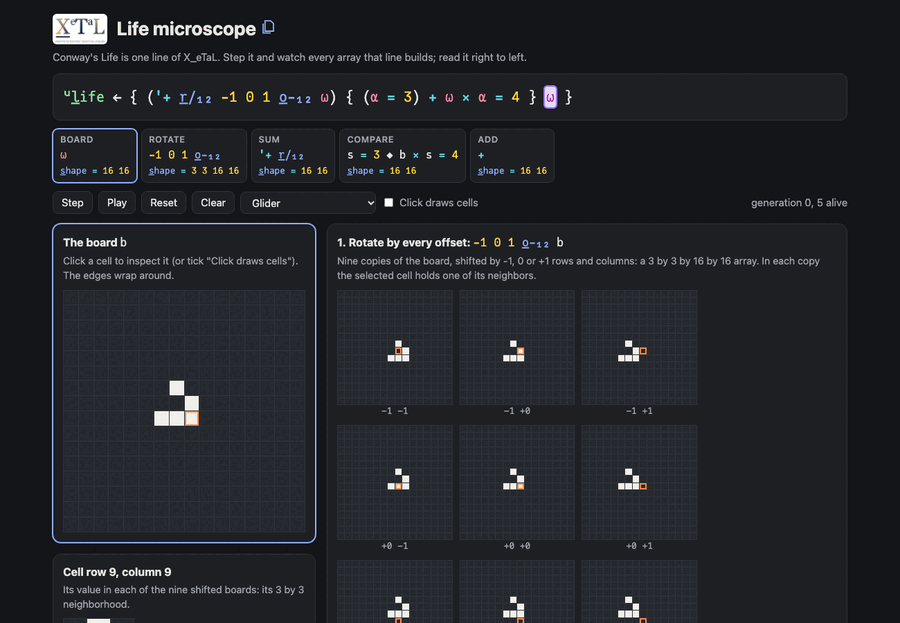
Conway's Life in one line of X_eTaL, with every array the line builds drawn: the nine shifted boards, their sum, the two masks, the next board. Click a cell to see its arithmetic.
Why arrays: Nine shifted copies of the board, summed: every cell's neighbors counted at once, with no loop over cells and none over neighbors.
ᵘl̲ife ← { ('+ r̲/₁₂ -1 0 1 o̲-₁₂ ⍵) { (⍺ = 3) + ⍵ × ⍺ = 4 } ⍵ }
rotate along axesreduce over axescomparison masksscalar extension
 Live
Live
Mandelbrot
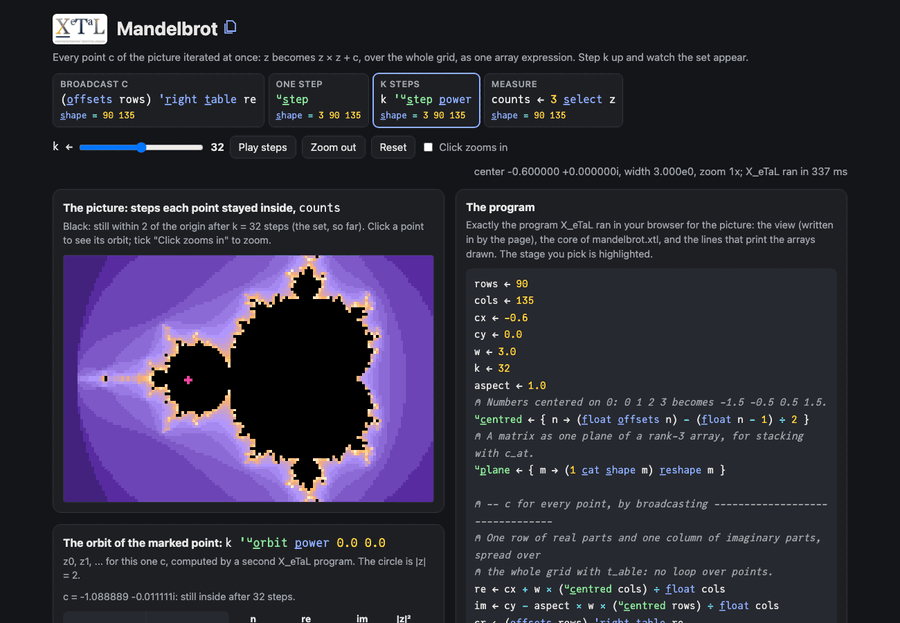
Every point of the picture iterated at once: z becomes z * z + c over the whole grid. Step k up and watch the set appear; click a point for its orbit, or zoom in.
Why arrays: z becomes z * z + c for every pixel at once: the whole grid is the argument, and a mask freezes the points that have escaped.
a ← (inside × cr + (zr × zr) − zi × zi) + (1 − inside) × zr
broadcasting with tablefunction powermasksrank-3 state
 Live
Live
Julia sets
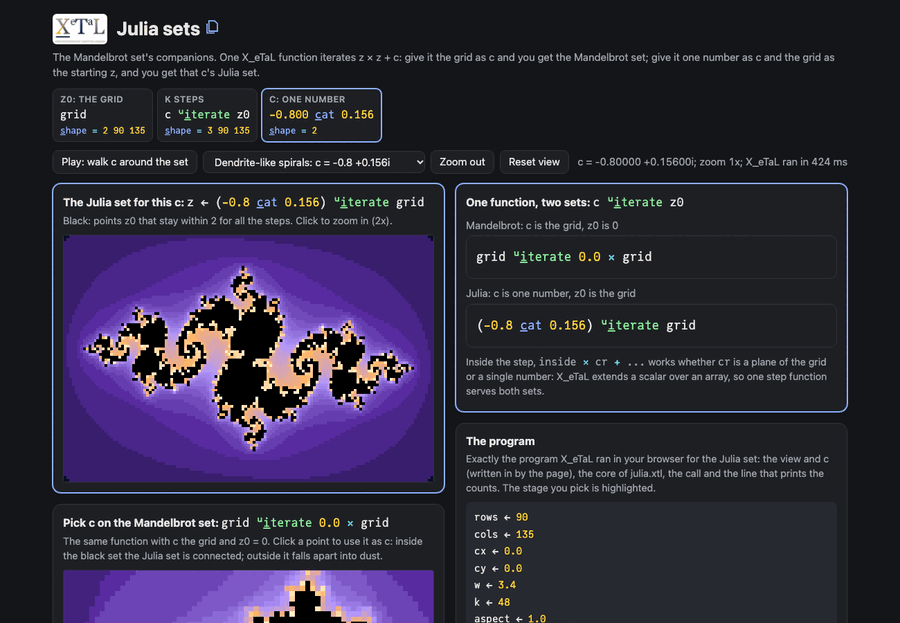
One X_eTaL function gives the Mandelbrot set (c the grid) and every Julia set (c one number, extended over the grid). Pick c on the Mandelbrot map, or play c around its edge and watch the Julia set morph.
Why arrays: The same step as Mandelbrot: c is one number here and a whole grid there, and the same code serves both (a single value extends over the grid).
inside ← f̲loat 4 ≥ (zr × zr) + zi × zi
scalar extensionbroadcasting with tablefunction powerdyadic functions
 Live
Live
Reaction-diffusion
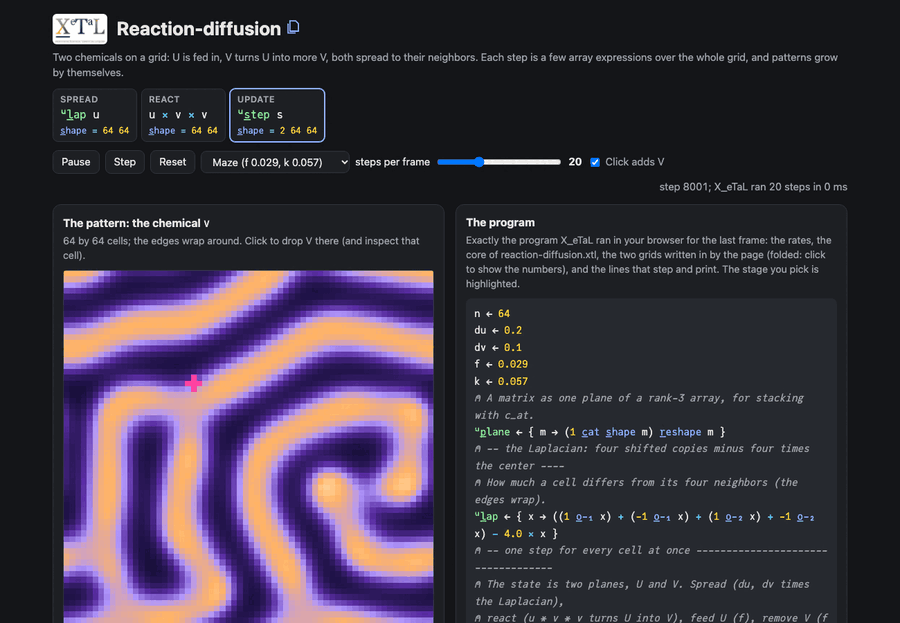
Gray-Scott chemistry on a grid: mazes, coral and spots grow by themselves. Each step is four shifts and a few products over the whole grid; click a cell to see its arithmetic, or drop more chemical.
Why arrays: Diffusion is four rotated copies of the grid minus four times the grid; the reaction is elementwise. Both apply to every cell at once.
ᵘl̲ap ← { x → ((1 o̲-₁ x) + (-1 o̲-₁ x) + (1 o̲-₂ x) + -1 o̲-₂ x) − 4.0 × x }
stencils by rotationelementwise arithmeticfunction powerrank-3 state
 Live
Live
Wave tank
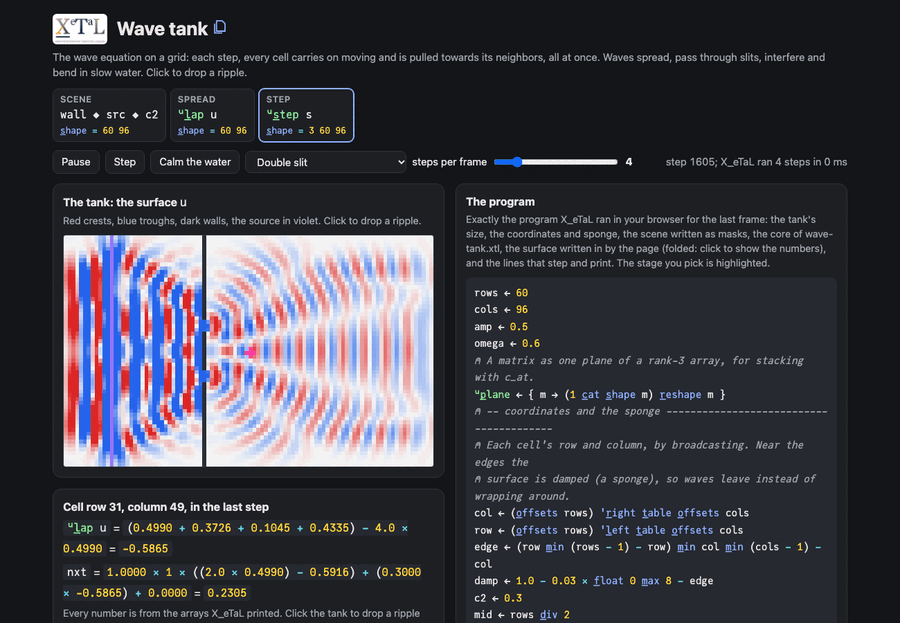
The wave equation on a grid: waves pass through a double slit and interfere, bend through a lens of slow water, and ripple where you click. Walls, sources and lenses are masks; each step is a stencil over the whole grid.
Why arrays: Every cell keeps its momentum and is pulled towards its neighbors in one expression; walls, slits and sources are just masks.
nxt ← damp × wall × ((2.0 × u) − p) + (c2 × ᵘl̲ap u) + drive
stencils by rotationmasksscalar extensionbroadcasting with table
 Live
Live
Cellular automata lab
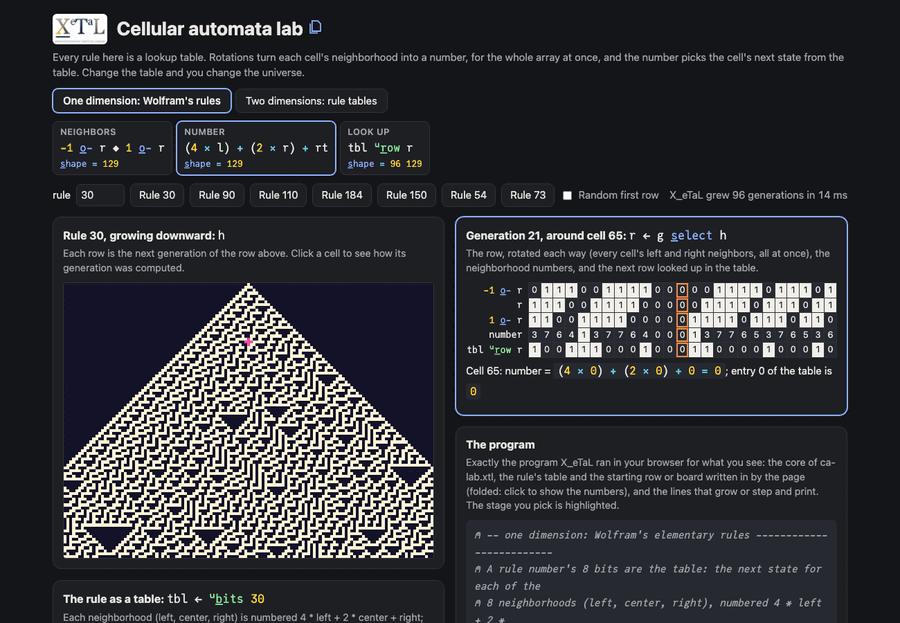
Every rule is a lookup table: rotations turn each cell's neighborhood into a number and the number picks its next state. Wolfram's Rule 30, 90 and 110 with an editable 8-entry table; Life, Brian's Brain and Wireworld as editable state-by-neighbors tables.
Why arrays: Any rule is a lookup table, indexed for every cell at once by its state and its neighbor count.
ᵘl̲ook ← { tbl b → (1 + (9 × b) + ᵘc̲ount b) s̲elect tbl }
rotationlookup by s_electreduce over axesfunction power
 Live
Live
Langton's ant
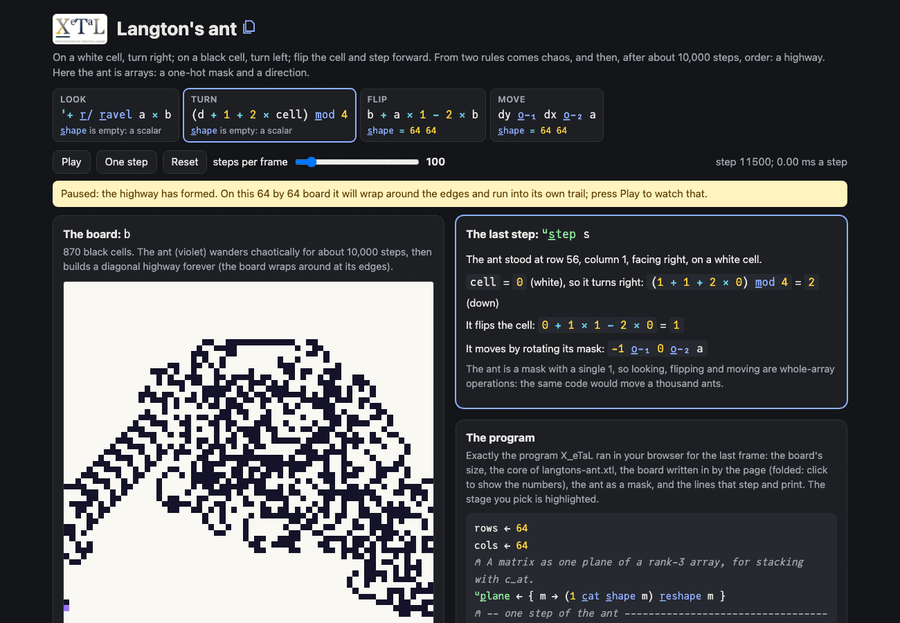
Two rules, chaos, then a highway after about 10,000 steps. The ant is a one-hot mask and a direction: looking, flipping and moving are whole-array operations, and the same code would move a thousand ants.
Why arrays: The ant is a mask with a single 1: looking, flipping and moving are whole-board operations, so a thousand ants would take the same code.
step ← dy o̲-₁ dx o̲-₂ a
one-hot masksrotationreducefunction power
 Live
Live
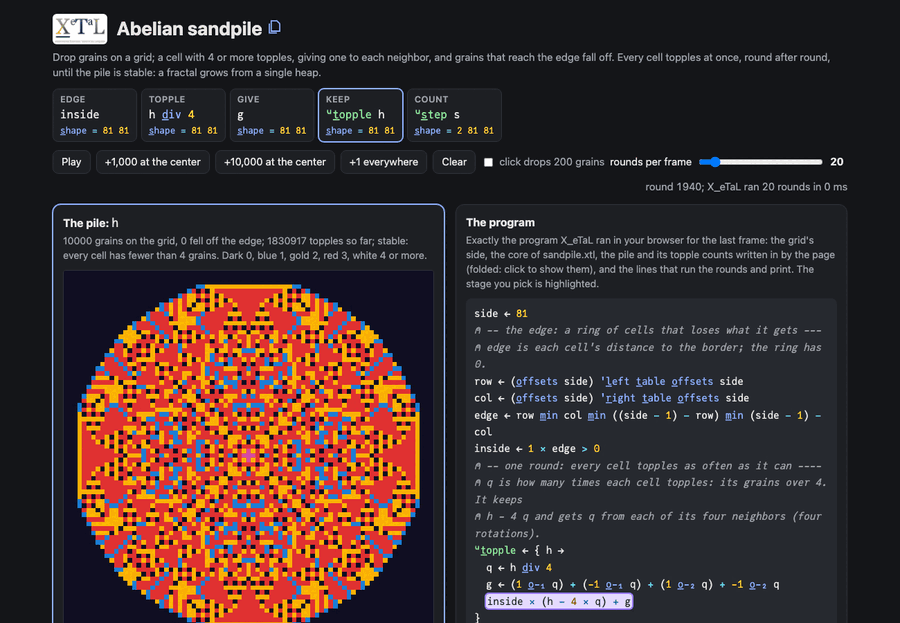
Abelian sandpile
Drop grains on a grid and watch avalanches: every cell with 4 or more grains topples at once, round after round, until the pile settles into a fractal. Drop more at the center, anywhere you click, or one everywhere.
Why arrays: Toppling order does not matter, so every cell topples at once, as often as it can: h d_iv 4, four rotations to share it, a mask for the edge. One expression a round.
inside × (h − 4 × q) + g
rotationsmasksinteger divisionpower
 Live
Live
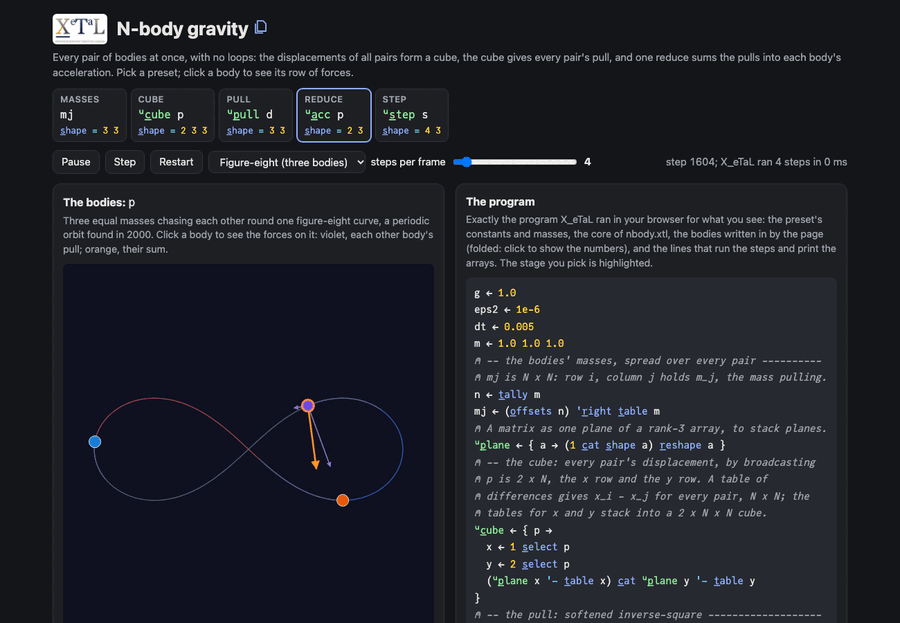
N-body gravity
Gravity between every pair of bodies at once, with no loops: the pairs' displacements form a cube, the cube gives every pair's pull, and one reduce sums them into accelerations. A figure-eight three-body orbit, a binary star with planets, a collapsing cluster, Kepler's ellipse.
Why arrays: Every pair at once: a table of differences is the N x N cube of displacements, and one reduce sums each body's pulls.
(ᵘp̲lane x '− t̲able x) c̲at ᵘp̲lane y '− t̲able y
broadcasting with tablereduce along an axisrank-3 arraysleapfrog integration
 Live
Live
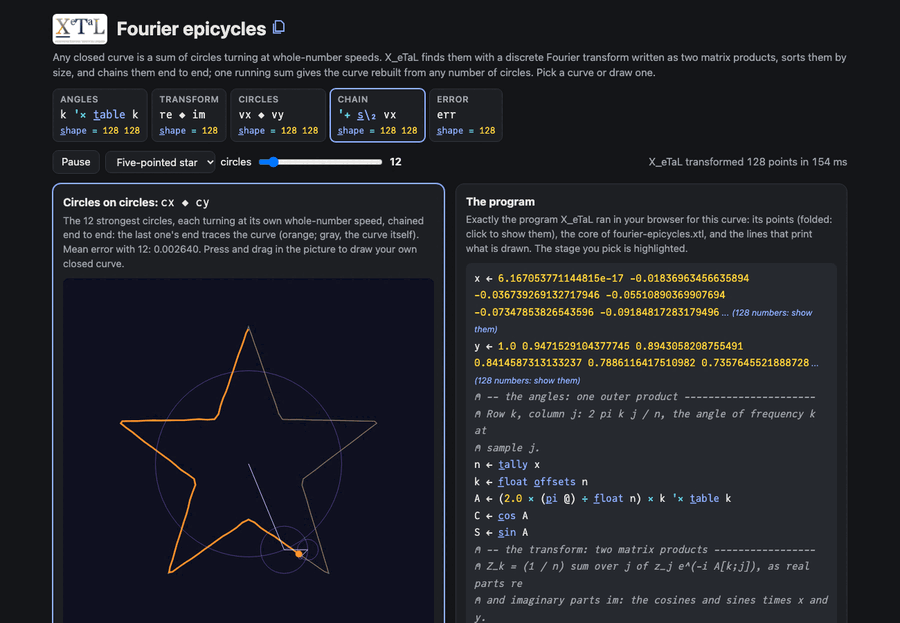
Fourier epicycles
Any closed curve is a sum of circles turning at whole-number speeds: a heart, a star, or one you draw, traced by circles on circles. The discrete Fourier transform is two matrix products; one running sum rebuilds the curve from any number of circles.
Why arrays: The transform is an outer product of angles and two matrix products; a running sum along the circles gives every reconstruction at once, so the circles slider needs no recomputation.
re ← ((C '+ '× i̲nner x) + S '+ '× i̲nner y) ÷ f̲loat n
outer product (table)inner productgradescan along an axis
 Live
Live
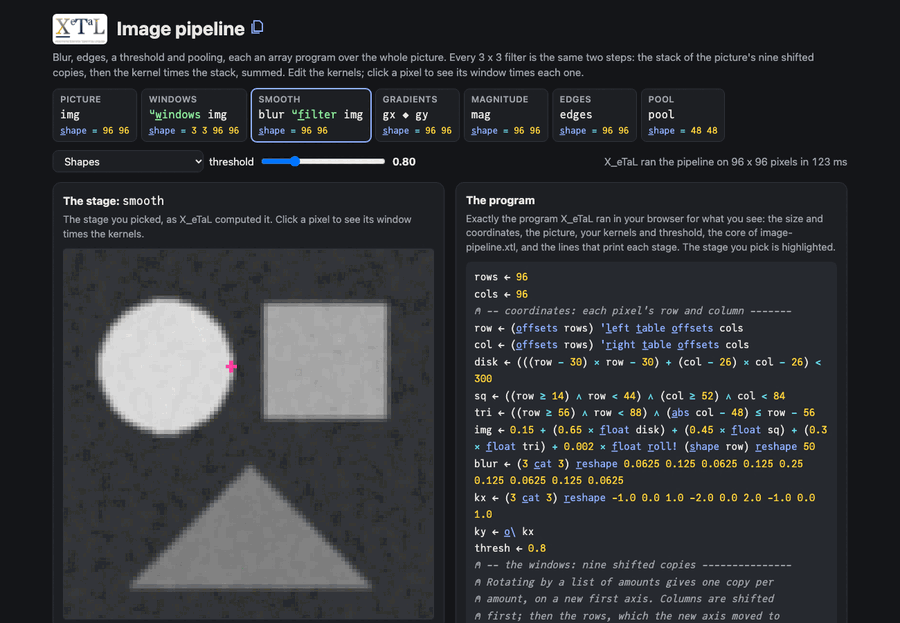
Image pipeline
Blur, Sobel edges, a threshold and max-pooling on a picture, each an array program. Every 3 x 3 filter is the stack of the picture's nine shifted copies times a kernel, summed; edit the kernels and click a pixel to see its window times each one.
Why arrays: Every 3 x 3 filter is the picture's nine shifted copies times a kernel, summed: blur and edges are the same function.
ᵘf̲ilter ← { k x → '+ r̲/₁₂ (ᵘw̲indows x) × k 'l̲eft t̲able x }
rotation by a list of amountsrank-4 arraysreduce over two axesreshape for pooling
 Live
Live
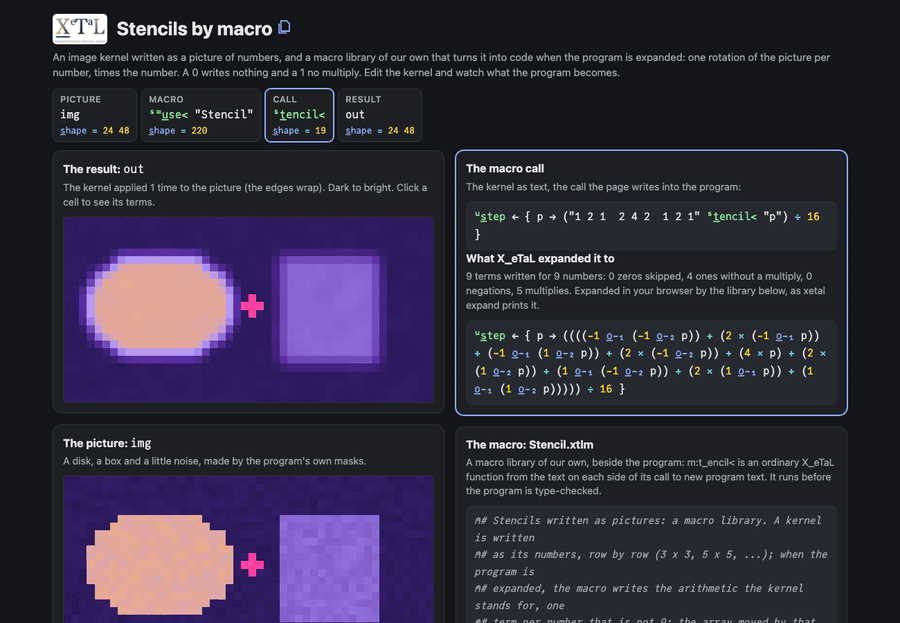
Stencils by macro
Image kernels written as pictures of numbers, turned into code by a macro library of our own when the program is expanded: blur, edges, sharpen, emboss and heat each cost exactly their nonzero numbers. See the call, what it expands to, and the result.
Why arrays: A kernel is data, but its zeros need not cost anything: a macro reads the numbers once, when the program is expanded, and writes one rotation per nonzero number, so the program is the unrolled stencil.
ᵘh̲eat ← { p → p + 0.2 × "0 1 0 1 -4 1 0 1 0" ˢt̲encil< "p" }
macro libraries (.xtlm)expansion (xetal expand)rotationspower
 Live
Live
Unix pipes in X_eTaL
cat, wc, grep, uniq, sort, head and tail as X_eTaL programs, chained with Unix pipes: xetalcat sample.txt | xetalgrep the | xetalsort | xetalhead -n 3. Each matches the real tool, byte for byte. Command line only.
Why arrays: Every character is numbered by its line (a running sum of newlines), so choosing lines is a mask and reordering them is a stable grade: no loop over lines in any stage.
sorted ← (g̲rade ln s̲elect rank) s̲elect t
text as arraysscangradecompressrotations